

IBS Integral Braking System
IBS Integral Braking System

Description
MAGURA Integral Braking System (IBS)
Innovation for cargo bikes: MAGURA to present a Integral Braking System for the first time
Optimum braking force distribution between the front and rear wheels is a crucial factor in short braking distances – and greater safety on the bike as a result. However, both brakes can only provide optimal deceleration values if they interact perfectly with one another. Pad wear evaluations by MAGURA show that the rear brake is usually used much more frequently in everyday use. Many cyclists seem afraid of the front wheel locking or skidding, so the front brake sees either little or no use. The inner calm and the routine to use both brakes optimally is often lacking, especially in unexpected dangerous situations, when everything happens so quickly. However, it's in situations like this that perfect braking is absolutely crucial.
Now the new MAGURA Integral braking system comes into play.
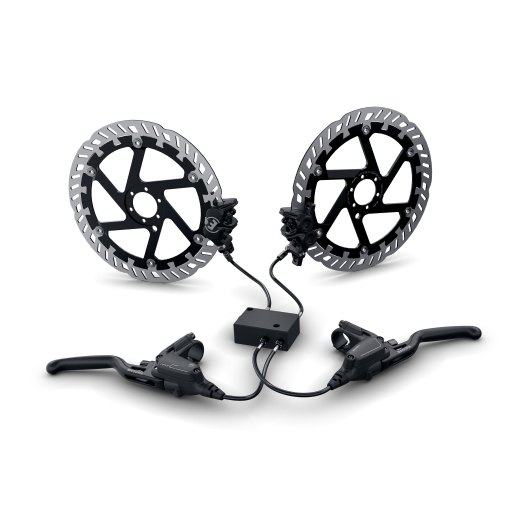
Specifically, the Integral Braking System functions as a brake force distributor between the front and rear brakes. When the rear brake is applied, the IBS also provides a simultaneous and proportional deceleration of the front wheel. Combining both brakes in this way provides much better deceleration. The distribution ratio to the front and rear wheels can be individually adjusted at the factory for each usage scenario or vehicle.
"The new Integral Braking System especially helps inexperienced riders to use both brakes together, significantly shortening the braking distance.
If you decelerate your bike mainly with the rear brake, you not only increase the wear on the rear brake enormously, you also lose safety and stability," says Christian Büchle, R&D MAGURA. A study shows that combined braking with the Integral Braking System leads to a braking distance that is about 40 % shorter - compared to braking without IBS using the rear brake (on a dry road). The stopping distance with the IBS is at about the same level as with optimal braking with front & rear brakes. If the IBS is used exclusively, a very good stopping distance can be achieved even in frightening situations.
The MAGURA Integral Braking System
The Integral Braking System from MAGURA complements the MT C disc brakes family – and it’s not much bigger than a pack of cigarettes. The IBS’s understated design is barely noticeable, and integration into wheel concepts is both possible and easily done.
The system works purely mechanically, without any power source. Special brake tubings with Easy Link couplings make handling easy. During servicing or maintenance, the IBS box can be disconnected from the tubing in just a few simple steps.
For the market launch, MAGURA first designed the IBS for cargo bikes, particularly for the “Long John” design, meaning two-wheeled cargo bikes on which the load is transported in front of the rider. Complete bikes with MAGURA IBS will be available in 2025 at latest.
The company is planning medium-term developments that will extend IBS usage scenarios to city, trekking and allroad bikes. A retrofit option is not planned for the time being.
Proven technology from the motorcycle sector
IBS systems have long been proven and established on motorcycles. MAGURA is once again using the technology transfer from its motorbike business division and is now bringing this technology to the bicycle as a world premiere. The IBS will complement MAGURA’s product range alongside its line of ABS brake components.
Whereas the Bosch eBike ABS with MAGURA brake components offers a fully electronic control function, the IBS technology is based on a purely mechanical-hydraulic system.
"The innovative MAGURA IBS technology is a further part in our efforts to promote mobility trends and to make the bicycle even safer. We’ve already demonstrated this in the past by introducing the first hydraulic brakes for bicycles and the first eBike ABS brake components," says Timo Müller Head of R&D / Productmanagement.
MAGURA press contact:
dominik.voss@magura.de
+49 (0) 160 92179740