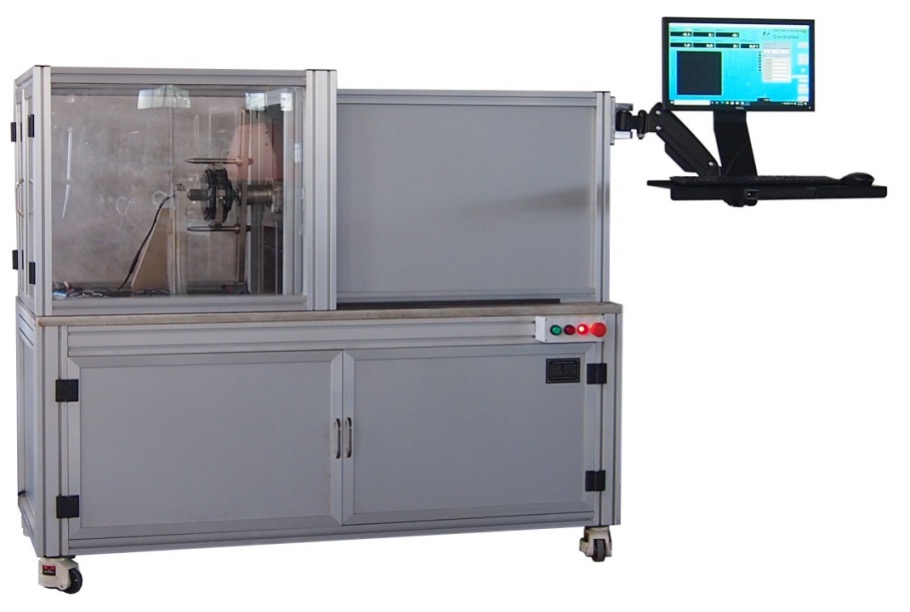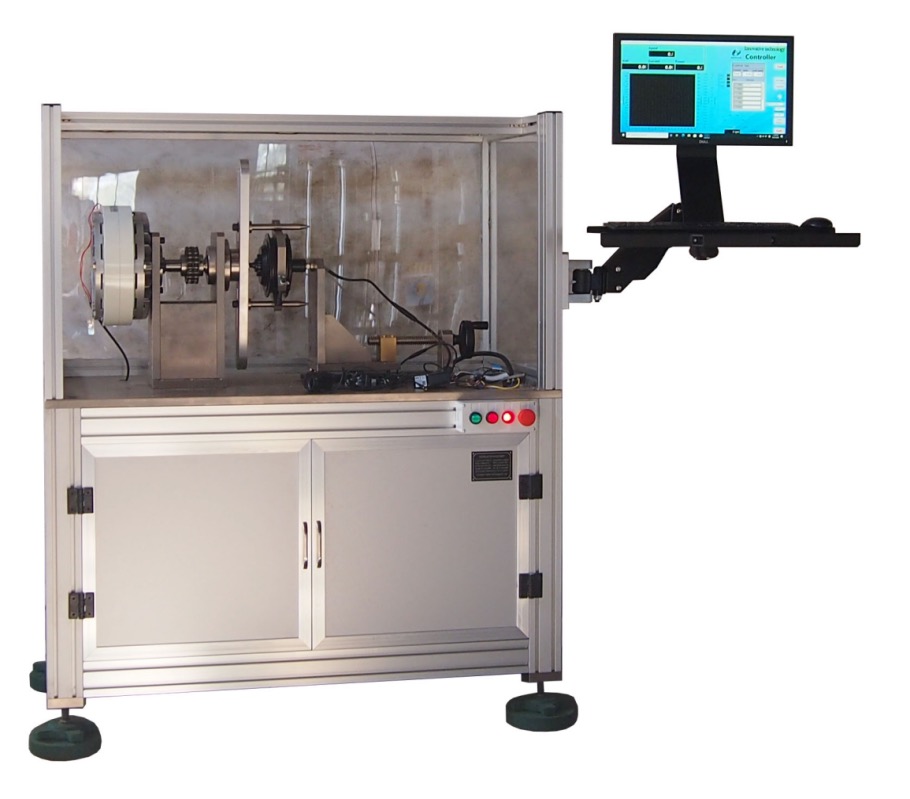


E-BIKE TESTING MACHINE SPECIFICATION
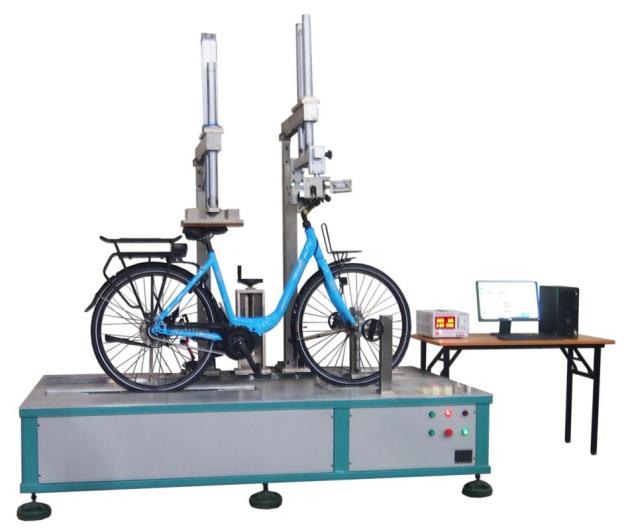
E-BIKE TESTING MACHINE SPECIFICATION
Beschreibung
Scope of application:
This machine is used to simulate the riding environment test of electric bicycles. The assembled finished bicycle is placed on the machine, and the weights and safety devices are adjusted according to the standard. After the relevant parameters are set on the computer, the computer automatically Perform the test.
Test principle:
Related test requirements:EN 15194-2017 4.2.11 4.2.12 4.2.13
Technical parameters:
1. Riding speed: 0 --- 30kmh
2. Accuracy of speed measurement:±1%
3. Accuracy of distance measurement: ±1%
4. Wheelbase of the test vehicle: 1000mm--1400mm
5. Driving method: servo drive
6. Drum diameter:Φ260mm(±10mm)
7. Loading method: seat cushion pneumatic loading
8. Fixing method of front and rear wheels: The fixing method of the front and rear wheels: the front and rear wheels operate independently, and the test piece is bound in all other directions.
9. Data acquisition system: American NI acquisition card
10. Motor: Panasonic servo motor, Panasonic servo controller
11. Overload shutdown: automatic detection
12. Control method: computer automatic control
13. Display mode: 15-inch LCD screen
14. Data storage: computer automatic storage
15. Report generation method: The computer automatically generates a report in the format requested by the customer
16. Power supply: 2KW 220V 50Hz
17. Regulated power supply: It is recommended that the user is equipped with a regulated power supply to ensure a stable current and voltage output. Because the seat cushion is pneumatically loaded, the current and voltage will fluctuate greatly. If the battery of the vehicle is not installed or the battery is low, it may affect the test effect.
Test content and method:
1. Test method:
a. The torsion resistance of the driving equipment roller can be set to T1:0-1000kg-cm and the output torsion resistance of the test bicycle can be calculated T2.
b. It can detect and record the mileage.
c. It can detect the battery input voltage V/current A/power W and record the use of ampere hours (A.HR).
d. It can detect and record the number of tire revolutions of the test run: N2 (RPM) and the number of revolutions of the test roller N1 (RPM).
e. It can calculate and record battery usage: A.HR (A.HR).
f. The test can be stopped when the battery voltage is lower than the set value.
2. Assist performance test: It is verified that the electric vehicle does not output power through the pedal during driving and the electric vehicle will automatically cut off the power to stop the power supply. After reaching a certain speed, the electric vehicle will automatically cut off the power to achieve the dual role of exercise and safety. When tested according to the method described in EN15194-2009 4.2.4.2, the computer automatically makes the following records:
1) The auxiliary power is only provided when the rider is stepping forward. When performing this test, the computer automatically starts the center axle of the bicycle under test, and automatically records the motor current of the electric vehicle at all times. When the central axis rotates in the forward direction, the current increases as the speed increases, and the current curve changes as the speed decreases;
2)When the rider stops pedaling forward, the auxiliary power must be cut off. The cut-off distance cannot exceed 5M if used with the brake lever cut-off switch, and cannot exceed 2M if the brake lever cut-off switch is not used. When performing this test, the computer automatically starts the center axle of the bicycle under test, and automatically records the current curve of the electric motor of the electric vehicle and the distance traveled by the roller after stopping the pedal, and automatically judges whether it is qualified.
3) When the bicycle reaches the designed maximum auxiliary speed, the auxiliary power output must gradually decrease and finally cut off. When performing this test, the computer automatically starts the center axle of the bicycle under test, and automatically records the motor current of the electric vehicle at all times, which is judged by the current curve.
4) The auxiliary power must be applied gradually and smoothly. When performing this test, the computer automatically starts the center axle of the bicycle under test, and automatically records the motor current of the electric vehicle at all times, which is determined by the current curve.
Perform this test ten times and take the average.
3. Start auxiliary mode
1) Run the vehicle at a speed of 80% of the maximum auxiliary speed declared by the manufacturer for 5 minutes for pretreatment, and then stop.
2) Run the start-up assist mode and verify the maximum design speed or minimum value when up to 6km/h..
3) When the start assist mode does not work, the computer automatically starts the rotation of the central axis to reach a certain speed and stops the computer to record the current curve. Observe that the current drops to a point equal to or less than the no-load current point during idling to verify that the speed drops to 0km/h.
4) Running start auxiliary mode
Verify that when the auxiliary mode is activated, the computer records the current curve and observes that the speed decreases when the current drops to a point equal to or less than the no-load current.
5) Run the startup assist mode and maintain it for 1 minute, verify that the speed is equal to or less than 6km/h.
4.Maximum vehicle speed test: The electric vehicle automatically measures the current curve of the electric vehicle when it reaches a certain speed through computer control, and its current curve begins to decrease downward. The computer records the speed when the current is at its maximum as its maximum speed.
5. Maximum power test: Automatically measure the torque and speed of electric vehicles through computer control. Automatically analyze the maximum power of electric vehicles through integration, and record the current and voltage at the same time to automatically measure the maximum efficiency of electric vehicles.
6. Continued mileage test and under-voltage protection test: After fully charged, the computer starts the auxiliary part to make it run at the highest speed, and automatically records its mileage, but the computer automatically stops the test when the electric vehicle is under-voltage protected.
7. 100-kilometer power consumption test: It can be powered by an external power supply or a battery. The computer automatically records the speed, mileage, current, and voltage, and automatically measures the actual power consumption at 100 kilometers.